Workshop
Three things to try out – at any time, even without the stations.
Your invitation card
An invitation to yourself – with a program for four weeks and your answer. Printable on one side, for the refrigerator or wallet.
🛟 When Faith Pressures – or Life
A good church sets you free: you may ask, doubt, leave. If someone persuades you that sickness or hardship are due to too little faith, if a group demands money, isolates or scares, this is a warning sign – up to spiritual abuse. Protection comes before cohesion.
- Telephone counselling (anonymous, free of charge, around the clock): 0800 111 0 111 · 0800 111 0 222 · 116 123 · Website
- Contact point.help – in case of abuse in evangelical church and diakonia, also in case of spiritual abuse: 0800 5040 112 · Website
- Help Phone Sexual Abuse: 0800 22 55 530 · Website
- Info phone depression: 0800 33 44 533
- Ärztlicher Bereitschaftsdienst · Notruf: 116 117 · 112
- Evangelical Centre for World Views – Information on religious groups Website
- Marriage, Family and Life Counselling (EFL) Wolfsburg: 05361 25325
- Diakonie Gifhorn: 05371 942626 · Website
Library: continue reading, continue listening
In the Bible
Books
- Dietrich Bonhoeffer, Resistance and Devotion. Letters from Detention (DBW 8)
- Martin Luther: The Little Catechism (1529) – Explanation of the third article
- Jörg Lauster, The Holy Spirit. A biography (C. H. Beck 2021)
- Jürgen Moltmann, The Spirit of Life (1991)
Technical literature and figures
- Christian Danz, Michael Murrmann-Kahl (ed.): Between mind forgetfulness and mind obsession (2014)
- Cecil M. Robeck Jr.: The Azusa Street Mission and Revival (2006)
- Pew Research Center: Christian population change 2010–2020 (2025)
- katholiken.de: Survey on Pentecost Knowledge (2024)
Listening and watching
- Gregorianik: “Veni creator Spiritus” and “Veni Sancte Spiritus”
- J. S. Bach: Choral Preludes “Come, Holy Spirit, Lord God” BWV 651 and 652
- Gustav Mahler: 8th Symphony, first part “Veni creator spiritus”
- Art: Pentecost in the Rabbula Gospel (586), Giotto (c.1310), El Greco (c.1600)
More at TCG-Ohof
The basis
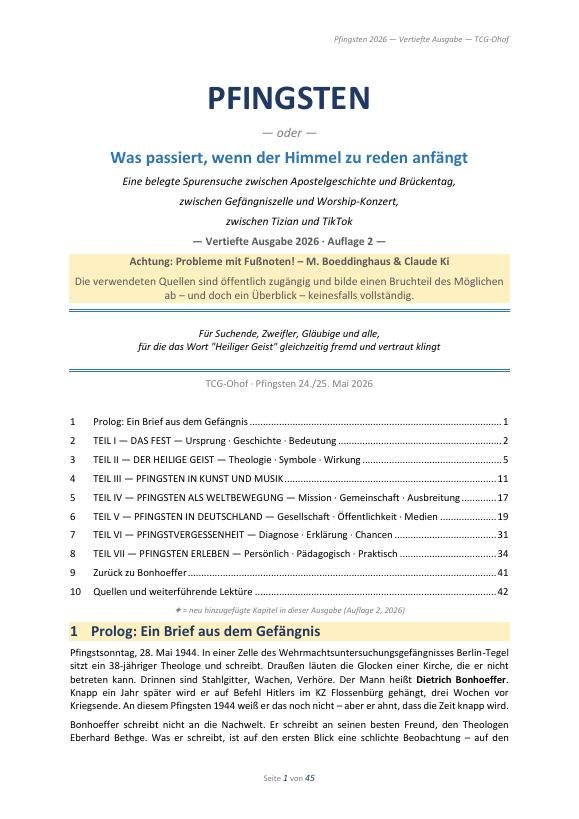
The course is based on the essay “Pfensten – or – What happens when heaven begins to talk” by Matthias Boeddinghaus with KI Claude (TCG-Ohof, In-depth issue 2026, 45 pages). Numbers, dates and citations were reviewed for the course and brought up to October 2026.
Read essay as PDF